Written By:
Avanii Thakur
Lead Editor
 PROCUREMENT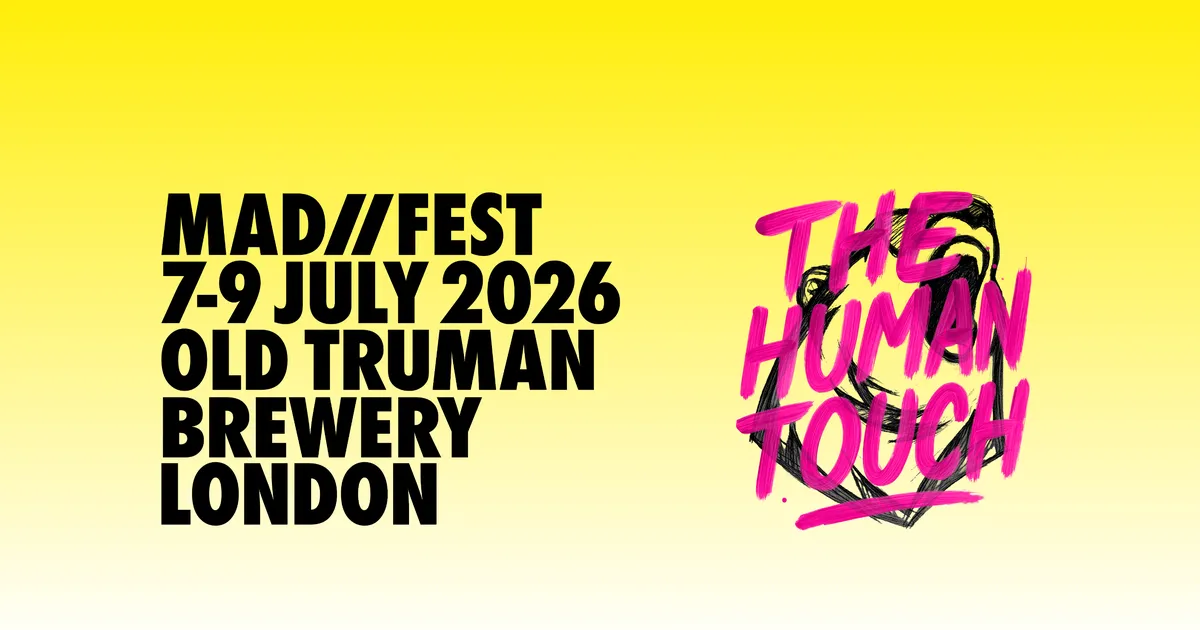

The UK’s biggest and boldest marketing festival returned to Shoreditch from 7-9 July, and this year’s theme couldn’t have been more timely. With ‘AI slop’ crowned Macquarie Dictionary’s Word of the Year, MAD//Fest declared 2026 the year of ‘The Human Touch’ – a rallying cry for an industry drowning in generic mush.
The line-up delivered on the promise: Louis Theroux, Munya Chawawa, Rory Sutherland, Sir Martin Sorrell, and speakers from Lego, Vaseline, Loreal, Burger King, Barclays, Domino’s and more, all wrestling with one question – in a world of infinite content, what actually makes people feel something?
We were there, notebooks out, lanyards on. Here’s our marketing conference takeaways:
Remember when brand trips were declared too extravagant, too tone-deaf, too 2019? (barring of course Refy’s infamous UGC-led Mallorca trip) Well, someone forgot to tell Space NK.
The beauty retailer’s return to the trip format sparked an interesting conversation in brand trips marketing: are they making a comeback? The short answer – yes, but not as we knew them.
The new wave of brand trips isn’t about flying twenty influencers to Bali to hold a serum near an infinity pool. It’s about curated, story-first experiences that give creators something genuinely worth documenting – and give audiences something genuinely worth watching. Almost like reality television. When the content feels like access rather than advertising, the format works. The speaker called out the industry’s obsession with organising brand trips quickly with no intent and no attention to detail.The brand trip never really died but the lazy brand trip did.
While every stage debates AI, one session argued that Monjaro will overtake AI as the force brands most urgently need to rethink around.
It sounds dramatic until you sit with it. Weight-loss drugs aren’t just a pharma story – they’re a GLP-1 consumer behaviour disruptor. Appetites are shrinking, snacking occasions are disappearing and the household is rethinking its spend on weekly groceries. Portion sizes, impulse buys, even the psychology of ‘treat culture’ – all of it is being quietly rewritten by a jab.
For FMCG, food, drink, fashion and beauty brands, this isn’t a niche health trend to monitor. It’s a fundamental shift in what, why and how much people consume. AI changes how brands make things. GLP-1 changes what people want.
If you needed hard numbers to take back to your CFO, System1’s session delivered the goods. Their System1 creator research, the Creator Effectiveness Playbook, put creators under a long-term lens; but the question that actually matters: are people remembering these ads?
The headline stat: creator content drives 23% more brand memory lift.
But before you rush to sign every creator with a ring light, here’s the catch – that average is being dragged up by a minority of exceptional campaigns. Not all creators are created equal, and the best-performing work shared a few things in common:
In other words: distinctiveness isn’t a nice-to-have. It’s the whole game.
Leave it to Munya Chawawa – satirist, actor, documentarian, and the internet’s fastest parody machine – to deliver the most quotable session of the festival.
His message to brands was refreshingly blunt: “You can demand more of us. Trust us more.” Involve creators earlier – in development, in meetings, in the actual creative process, rather than parachuting them in at the end to read a script. The creator economy, he said, feels like a non-stop train, and too many brands treat creators as an outlet you pay to say words. The opportunity is so much bigger.
His anatomy of a bad brief was painfully familiar. It starts with flattery: “We’re SO excited to work with you, we love the parodies, we love the character work!” And then, layer by layer, the brand strips away everything audiences actually love the creator for – until what’s left is a talking head saying some words. “But that’s not me???”
The creators who win, Chawawa argued, should be treated less like media placements and more like creative directors. They know their audience better than any planning deck ever will.
If you want to dive more into this, we covered research that targets this very pain point in our latest whitepaper.
Louis Theroux’s keynote led had lines that wrapped around the fest. The festival’s headline booking brought the human touch in its rawest form. Louis Theroux took the stage to unpack the making of Inside the Manosphere – his Netflix documentary exposing the ultra-masculine influencer ecosystem and the young audiences it captures.
Theroux’s session was a masterclass in the uncomfortable side of the creator economy, giving examples of his time working with the manosphere’s finest. The manosphere’s biggest figures are, in a dark mirror of everything else discussed at MAD//Fest, exceptional content marketers: livestreaming around the clock, clipping everything, and building parasocial loyalty at industrial scale. As Theroux put it elsewhere – it’s highly profitable to be awful on the internet.
For marketers, the warning was implicit but unmissable. The same algorithmic machinery that put F1 drivers on every ‘For You’ page is radicalising a generation of teenage boys. Brands can’t pretend the attention economy is neutral territory – knowing where your media money flows, and who it platforms, is no longer optional homework.
It’s the same uncomfortable territory the Louis Theroux manosphere documentary set out to expose, and one MAD//Fest clearly wanted its audience to sit with.
As delegates poured out of the Truman Brewery (sunburnt – MAD//Fest even issued a high-temperature warning), the throughline of 2026 was impossible to miss: the industry’s future belongs to whoever masters the human bit.
Our predictions from this year’s insights, coming soon!







30M
IMPRESSIONS
15%
UPLIFT IN SALES
17M
REACH


70M+
IMPRESSIONS
500+
COLLABORATIONS
SOLD OUT
PRODUCT LINES


486%
FOLLOWERS
28M
MENTIONS
13M
VIEWS

35M
VIEWS
3M
ENGAGEMENTS
50+
CREATORS


32M
VIEWS
+400K
NEW FOLLOWERS
2M
LIKES

We'll show you how to start powerful conversation, drive social engagement, build your brand, hit sales targets or meet other goals you have, wherever you are in the world.
Work with us