Written By: Anastasija Vasilevska
Writer
 PROCUREMENT



If your ads have started to feel a little too polished for their own good, you’re not imagining it. Audiences can now spot a scripted brand shoot from a mile away, and they’re scrolling straight past it.
That’s a big part of why UGC-style content has taken over. Testing moves fast, and teams need to keep up with it. Knowing how to find UGC creators quickly has become one of the strongest skills a marketing team can have.
When comparing content creators vs. influencers, UGC-style content often performs better because it does not immediately look or feel like an advert. Instead, it resembles a recommendation from a real customer – something audiences are more inclined to trust.
UGC ads typically convert at between 3–6%, compared with 1–3% for traditional brand creative. They can also achieve higher click-through rates and lower cost-per-click. On product pages, creator content can meaningfully increase conversions by providing valuable social proof and presenting products in a relatable, everyday context.
Most marketing teams no longer need convincing that UGC works. The challenge is in finding creators who can produce authentic, platform-native content consistently and at the volume required for modern creative testing.
When brands need multiple hooks, formats and creative variations, manually searching through hashtags quickly becomes the bottleneck. The priority therefore needs to shift from proving the value of UGC to developing a faster, more reliable way of finding the right creators.
Not every talented creator makes for a good UGC creator. Before you shortlist anyone, check for:
One thing that matters less here than you’d expect: follower count. A UGC creator’s personal audience is often irrelevant, since the content runs on your channels, not theirs. Engagement rate takes a back seat to fit.
This is where the search process itself changes. Instead of filtering by rigid fields such as age, location or follower count, describe what you are actually looking for in plain language and let AI search interpret it. That is what it means to find creators by natural language, and it is a vastly different approach from the one most marketers are used to.
A couple of examples of what that looks like in practice:
Hashtag search only tells you who has used a particular tag; it says nothing about their tone, pacing or delivery. An AI tool like ARIA can analyze all of these things at once – something hashtag searches cannot do.
To improve the quality of the match, be specific about the setting and production style you want. A bathroom-mirror selfie, outdoor demonstration or desk-based unboxing can each create a very different tone.
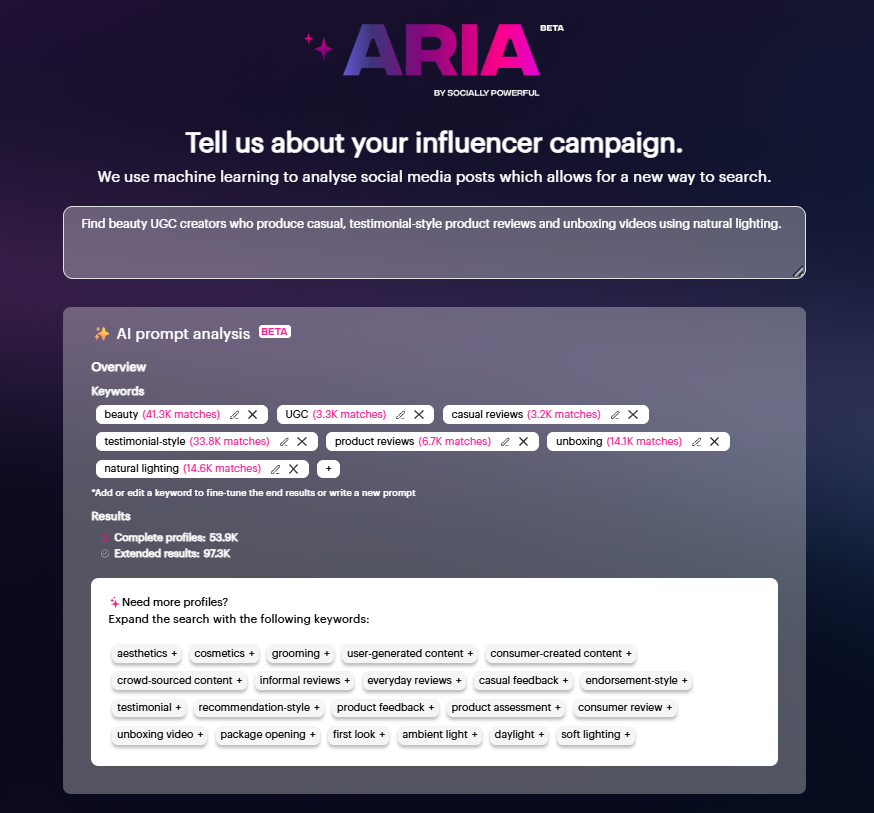
Once your natural-language search returns a pool of candidates, tagging provides a shortcut for narrowing it further. The UGC creator tag sometimes labelled “Blogger” filters specifically for creators whose content leans towards the testimonial style rather than perfectly polished influencer content.
Run the natural-language search first to create a style-matched pool, then apply the tag if the results appear too polished or influencer-led. This combination is particularly useful for brands that do not want to operate separate tools for UGC sourcing and general creator discovery.
Natural-language search paired with tagging is what makes this a full UGC influencer discovery platform rather than just a UGC creator search tool.
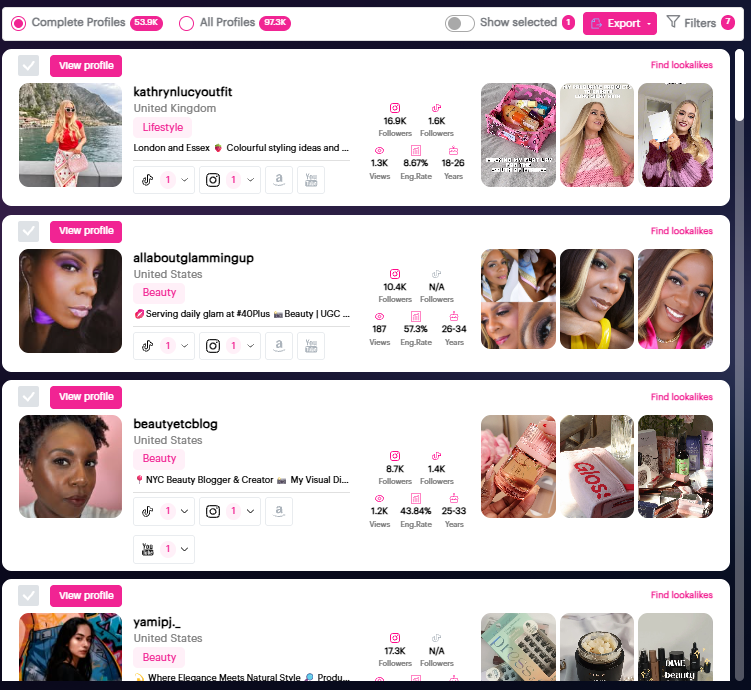
A style match from search is only the starting point. Before you commit to a shortlist, spot-check it:
A quick gut-check: would this post make sense sitting in someone’s personal feed, or does it read as an ad the second you look at it? This step is what separates a good search from actually knowing how to find UGC creators for brands who’ll deliver consistently.
Once your shortlist is vetted, don’t let the momentum stall:
Finding the right creators used to mean hours of hashtag digging and a great deal of guesswork. But now that we have natural-language search, marketers can spend more time on vetting and let the tool do the matching. That is the real shift in how to find UGC creators for brands today: less digging, more describing.
Ready to try it yourself? Start a search with ARIA and describe the creator you’re picturing, no filters required.







30M
IMPRESSIONS
15%
UPLIFT IN SALES
17M
REACH


70M+
IMPRESSIONS
500+
COLLABORATIONS
SOLD OUT
PRODUCT LINES


486%
FOLLOWERS
28M
MENTIONS
13M
VIEWS


35M
VIEWS
3M
ENGAGEMENTS
50+
CREATORS


32M
VIEWS
+400K
NEW FOLLOWERS
2M
LIKES

Aug 20, 2026
Insights

Aug 14, 2026
Insights

Jun 26, 2026
Influencer Marketing

Jun 12, 2026
Influencer Marketing

We'll show you how to start powerful conversation, drive social engagement, build your brand, hit sales targets or meet other goals you have, wherever you are in the world.
Work with us